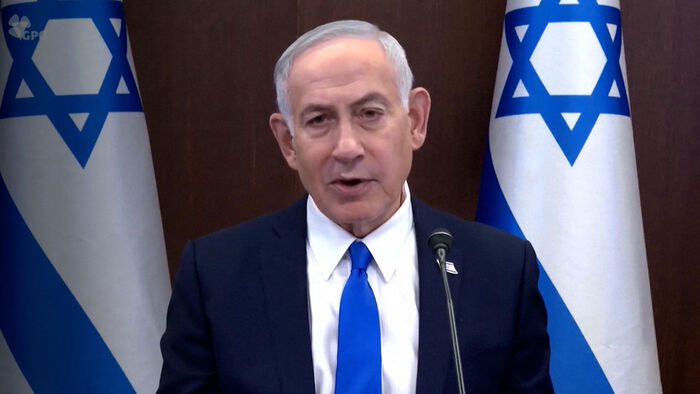
▲ Israeli Prime Minister Benjamin Netanyahu
Local media reported that Israeli Prime Minister Benjamin Netanyahu was briefly in a state of panic following an agreement on a new "Lebanon conflict prevention mechanism" reached during high-level follow-up talks on ending the war between the U.S. and Iran in Switzerland.
Citing a senior Israeli official, Israel's Channel 12 reported that once the agreement to introduce a conflict management system regarding Lebanon was reached during the high-level U.S.-Iran talks, Prime Minister Netanyahu feared that the actions of his country's forces stationed in Lebanon would be restricted or that Israel would be excluded from the management system.
The broadcaster reported that Netanyahu, who has insisted on the right to respond to threats from Hezbollah and to maintain troops in southern Lebanon, subsequently launched an all-out diplomatic effort to dispel these concerns and protect Israel's interests.
Qatar and Pakistan, the mediators of the ceasefire negotiations, stated in a joint statement after the talks concluded that "the parties (the U.S. and Iran) have agreed to establish a 'de-escalation mechanism' between the parties and Lebanon, with the assistance of the mediators, to ensure compliance with the end of military operations in Lebanon in accordance with the MOU."
U.S. Vice President J.D. Vance, the head of the U.S. negotiating team, also announced yesterday that a new "conflict prevention mechanism" had been established.
It is reported that this new system will replace the existing body—which included Israel, Lebanon, the U.S., France, and the UN under the mediation of the U.S. Biden administration in 2024—with a new consultative group consisting of the U.S., Iran, Lebanon, Qatar, and Pakistan.
However, a senior U.S. official denied rumors that Israel would be excluded from the new system.
The official emphasized that given the close relationship between the U.S. and Israel, a direct channel between the U.S. and Iran would actually be beneficial to Israel.
Nevertheless, it remains unclear whether the official's remarks mean that Israel will take on a formal role in the new mechanism or if Israel's interests will be indirectly represented through coordination with the U.S.
Channel 12 added that while the 2024 system aimed to coordinate between Israel and Lebanon on efforts to collect and remove Hezbollah's weapons, the new mechanism focuses on preventing direct physical friction between the Israeli military and Hezbollah.
The issue of Lebanon is the most sensitive topic for Israel in the U.S.-Iran ceasefire negotiations.
It is reported that Prime Minister Netanyahu, judging that other Israeli officials, including Yehiel Leiter, the Israeli Ambassador to the U.S., could not effectively handle this issue, urgently deployed his close aide, former Minister of Strategic Affairs Ron Dermer, to engage in consultations with the U.S.
Senior U.S. officials reportedly held multiple phone calls with former Minister Dermer during the negotiations in Switzerland to share key developments, including the situation in Lebanon.
In particular, Channel 12 reported that the post on the social media platform Truth Social by U.S. President Donald Trump, warning that he would take military action if Iran failed to restrain Hezbollah, was also a result of former Minister Dermer's active intervention.
※ Please note: This article was translated by AI and may contain errors.